Why Lyme, NH's Cheapest-Looking Acreage Isn't Always the Better Deal
September 3, 2026
September 3, 2026
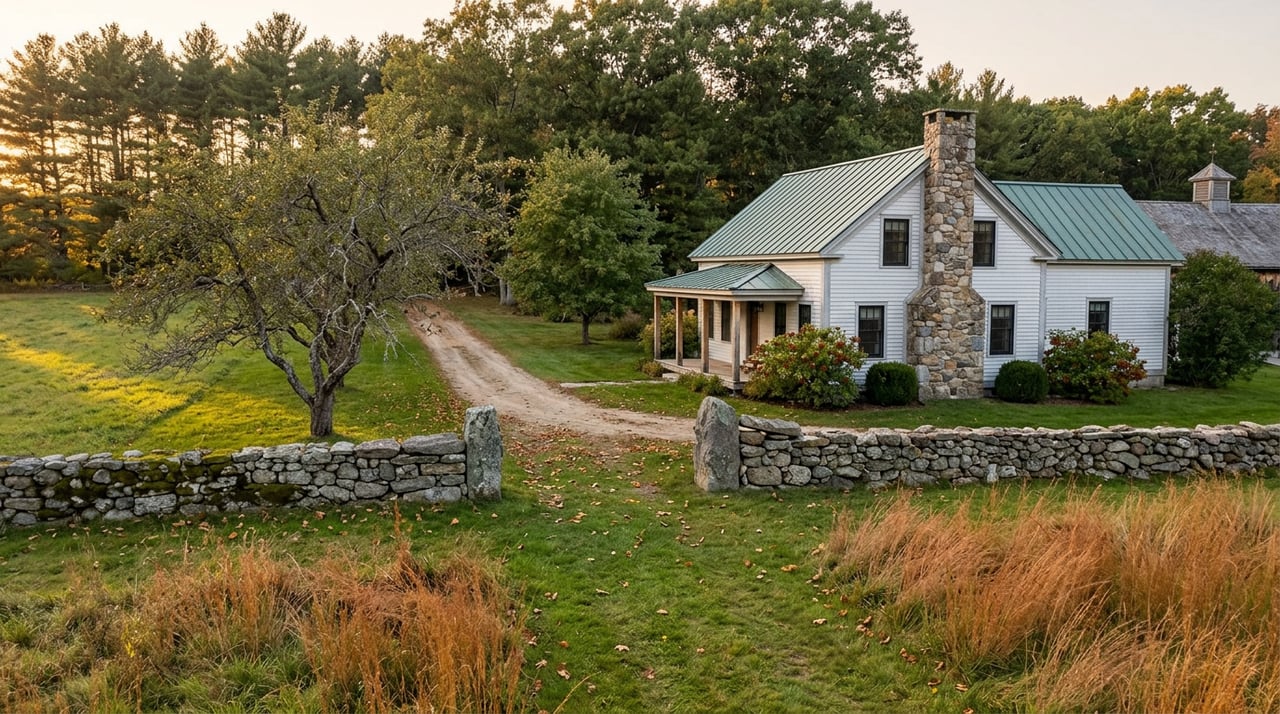
Two listings turn up in the same search of Lyme land this fall. Both sit within a mile of the village common. Both come with old stone walls, a mix of hardwood and hemlock, and a farmhouse that needs some work. One is priced meaningfully higher than the other. A buyer who has only looked at portal photos will assume the cheaper parcel is the find of the season.
It usually isn't. In Lyme, and across the rest of rural Grafton County, the price on the sign rarely reflects the two things that actually decide what you can do with the land: how the town classifies the road that reaches it, and whether the acreage sits in New Hampshire's Current Use program. Neither shows up in a listing photo. Both can add cost, delay, or a flat denial to a project the buyer assumed was straightforward.
New Hampshire sorts every road into a class, and the distinction that matters most to a rural buyer is the line between a Class V road, which the town is obligated to maintain, and a Class VI road, which it is not. Under state law, a road drops to Class VI once it has gone without town maintenance for five straight years, or after a town formally discontinues it and puts it "subject to gates and bars."
"...not been maintained and repaired by the town in suitable condition for travel thereon for 5 successive years or more."
That's the statutory language, and it explains why a road can look perfectly drivable in August and still carry no promise from the town that it will be plowed, graded, or repaired at all.
Lyme takes this seriously enough to have formed its own Class V Roads Study Committee, a standing body tasked with reviewing the condition of the town's maintained roads and recommending where repair dollars should go. The town has also posted a six-ton weight limit on its roads, and anyone who needs an exception has to call the Road Agent directly for written permission. Mud season shows up in the town's own communications too, with specific roads like Pinnacle Road flagged for the seasonal wear that comes with the spring thaw. None of this is a hypothetical inconvenience. It's an active piece of town governance that a buyer should ask about before assuming a road will hold a moving truck in April.
For decades, landing on a Class VI or private road did more than complicate your commute. Under RSA 674:41, most New Hampshire towns treated a building permit application on one of these roads as an almost automatic denial, largely over concerns that emergency vehicles couldn't reliably reach a structure. That changed in 2025. Two amendments, Chapter 175 for private roads and Chapter 256 for Class VI roads, rewrote the permitting process to make approval realistic rather than theoretical. The reform doesn't erase every hurdle. A lot on a Class VI road may still need a frontage variance from the zoning board before a permit can move forward, and each town retains its own process for reviewing the request. What changed is the presumption. A road that used to mean an automatic no now means a longer conversation, not a dead end.
The other mechanism sits in the tax code, not the road book, and it shapes nearly every large parcel in Lyme because so much of the town's inventory is exactly the kind of acreage the program was built for.
New Hampshire's Current Use program, under RSA 79-A, lets landowners with ten acres or more of qualifying farmland, forest, or unproductive open land pay property tax on what that land produces rather than on its value as a building lot. It's a real discount, and it's a major reason rural land in towns like Lyme carries a lower carrying cost than its raw market value would suggest.
The catch arrives the day someone builds. Taking any portion of enrolled land out of Current Use triggers a one-time Land Use Change Tax equal to ten percent of that portion's market value at the time of the change, assessed only on the acreage actually disturbed, not the whole parcel. Build a house and driveway on two acres of a twenty-acre enrolled lot, and the town bills ten percent of what those two acres are worth as buildable land, calculated at the moment you break ground. The rest of the parcel can stay in Current Use and keep its lower tax bill indefinitely, but the ten percent isn't optional and there's no way to buy out of it early.
None of this is disclosed automatically. A seller isn't required to volunteer that ten of their fourteen acres are enrolled, or that a previous owner already triggered a partial Land Use Change Tax that's still working through the town's books.
| Parcel on a town-maintained road, no Current Use | Parcel on a Class VI road, 18 acres in Current Use | |
|---|---|---|
| Access | Town plows and grades year-round | No town obligation to plow, grade, or repair |
| Financing | Standard underwriting | Lender may require extra documentation or decline |
| Building permit | Routine review | Requires select board approval, possibly a frontage variance |
| Property tax today | Assessed at full market value | Assessed at productive-use value, lower bill |
| Cost to build later | None beyond standard permitting | 10% Land Use Change Tax on the disturbed acreage |
| Mud season | Non-issue | May carry a posted weight limit |
The lower list price on the second parcel isn't a discount waiting to be claimed. It's compensation for the buyer who will do the work of confirming road status, lining up financing that accounts for it, and budgeting for the tax bill that arrives the day construction starts.
Does Current Use enrollment end when the land changes hands? No. The classification stays with the land through a sale. The new owner inherits both the lower tax bill and the obligation to pay the Land Use Change Tax if they later develop any of the enrolled acreage.
Can you get a mortgage on a Class VI road at all? Sometimes, but it depends on the lender. Portfolio lenders and local banks that hold loans in-house tend to have more flexibility than lenders selling into the secondary market, since Class VI status can complicate appraisal and marketability assumptions.
What if I only want to renovate the existing house and never touch the rest of the acreage? Renovating within the existing footprint generally doesn't disturb Current Use status or trigger the Land Use Change Tax, since the penalty applies to acreage that changes use, not to work on an already-improved building envelope. Confirm the specifics with the town assessor before you start, since interpretations can vary.
Lyme's stone walls and working forest are exactly what draw buyers north from Hanover in the first place. The land is real, the privacy is real, and so are the two mechanisms that decide what you can actually do with it. A buyer who checks the road classification and the Current Use status before writing an offer isn't slowing the process down. They're the one who won't be surprised at the closing table.
If you're weighing a rural parcel in Lyme or comparing it against options elsewhere in the Upper Valley, Alan DiStasio can walk through the road and land use specifics on a given property before you make an offer. Request a complimentary market assessment to start that conversation.
Stay up to date on the latest real estate trends.
September 24, 2026
September 17, 2026
September 10, 2026
September 3, 2026
August 27, 2026
August 6, 2026
Life In The Upper Valley
August 6, 2026
Life In The Upper Valley
July 23, 2026
Market Intelligence
July 16, 2026
Get assistance in determining current property value, crafting a competitive offer, writing and negotiating a contract, and much more. Contact me today.