Orford's Ridge Houses: The National Register Listing Won't Pay for Your Renovation
September 10, 2026
September 10, 2026
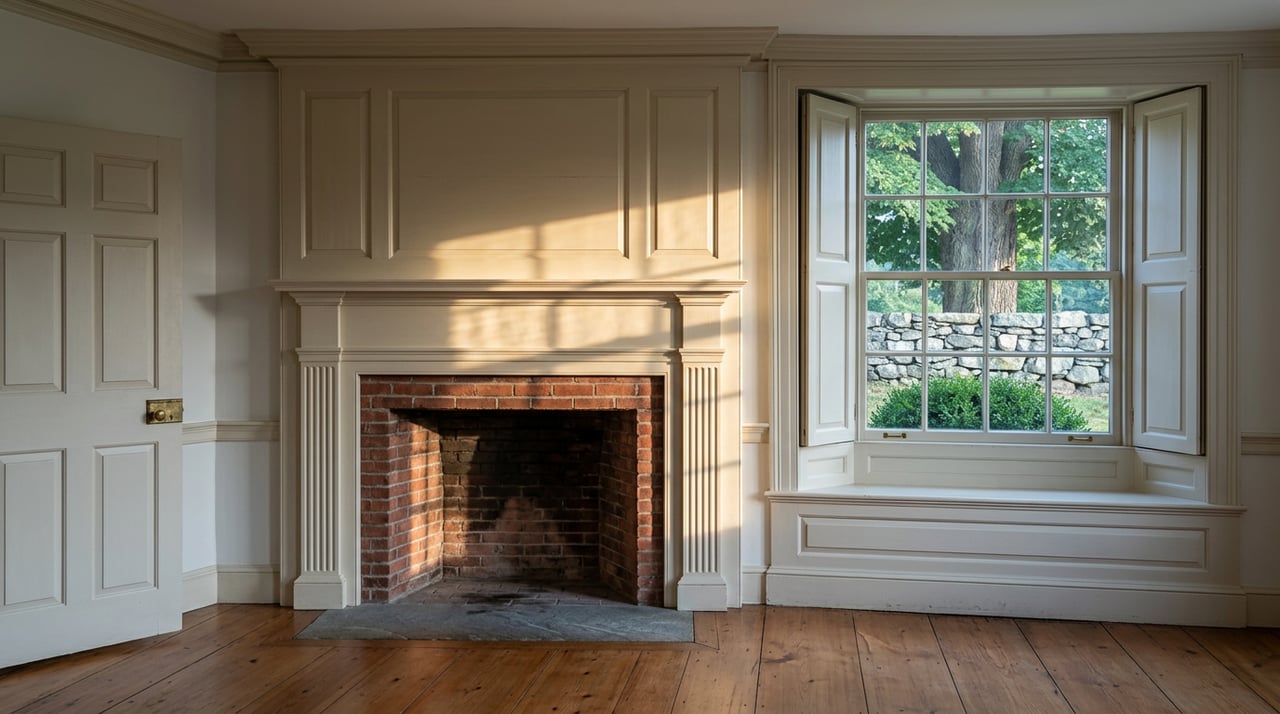
Walk the row of seven homes on Orford's Main Street and it is easy to assume the National Register plaque comes with a checkbook attached. These are, after all, some of the most photographed Federal-style houses in New England, listed on the National Register of Historic Places since 1977 as part of the Orford Street Historic District. Buyers touring the Hinckley House or asking about the Rogers House often arrive with the same unspoken assumption: a listing this prestigious must qualify for historic tax credits, preservation grants, some kind of institutional support that offsets the cost of owning it.
It doesn't, not in the way most buyers picture. The prestige is real. The money is not automatic. And the gap between those two facts is where buyers and sellers of Ridge Houses get tripped up, sometimes at the worst possible point in a transaction.
The seven Ridge Houses sit on elevated land east of Main Street, a stretch that was once the bank of the Connecticut River before the water receded and left a terrace behind. They were built over a span of decades, from 1773 to 1839, by prosperous Orford residents including a local attorney named John Rogers, whose 1817 house became one of the row's best-known examples. Daniel Wheeler and his brother John B. Wheeler built the southernmost house in the row, completed in 1807. Together the seven homes make up a documented, nominated, federally recognized historic district, and that documentation is public record through the National Park Service.
None of that recognition is in dispute. What is misunderstood is what the recognition actually entitles an owner to receive.
The federal government does offer a real incentive for rehabilitating certified historic structures: a 20 percent income tax credit on qualified rehabilitation expenses. It is a genuine program, actively used across New Hampshire. It is also, by design, unavailable to the exact buyer who most wants it. The credit is restricted to income-producing historic buildings. Owner-occupied residential properties do not qualify, full stop. A family buying a Ridge House to live in it, not to rent it out or run a business from it, gets no access to that 20 percent credit regardless of how carefully the restoration follows the Secretary of the Interior's standards.
This single distinction is the most common source of confusion buyers bring into a Ridge House purchase, and it is worth stating plainly before anyone gets attached to a renovation budget that assumes federal help arriving later.
New Hampshire does fund historic preservation, through the Land and Community Heritage Investment Program, known as LCHIP. The program is real and well capitalized. Since 2008, LCHIP grants have been supported by a $25 surcharge on documents recorded at the state's ten county registries of deeds, generating between $3.5 million and $5 million a year for preservation and conservation work statewide.
But LCHIP funds do not go to private homeowners. To qualify for a historic rehabilitation grant, a resource has to be publicly owned or owned by a publicly supported nonprofit exempt from federal taxes, and it has to be listed on, or eligible for, the State or National Register. A private individual who buys a Ridge House as a residence cannot apply directly for LCHIP money to fund a new roof or a foundation repair, no matter how architecturally significant the house is documented to be.
This is not a technicality. It is the reason the town, not a private seller, has been the one structuring the Rogers House's protection twice over. In 2017, after the previous owner lost the property to a tax sale, Orford's Selectboard arranged a sale to a young family who agreed to work with the New Hampshire Preservation Alliance to restore the house, with an easement held by the Alliance attached to the deed going forward. In 2022, the town again arranged a sale of that same protected Ridge House, this time to a buyer with earlier ties to Orford, with the Alliance's easement still enforceable against the new owner. Both times, it was the town's involvement, not a private transaction alone, that put the preservation structure in place. A private buyer purchasing a Ridge House directly from another private owner today is not stepping into that same institutional pathway. They are simply buying a house, one that may or may not already carry a recorded easement from an arrangement like this one.
There is a third option, and it is the only one with a plausible path for an individual owner: RSA 79-E, New Hampshire's Community Revitalization Tax Relief Incentive. Where a municipality has adopted it, the statute lets a property owner forgo the property tax increase tied to a qualifying rehabilitation project for a period of up to fifteen years.
The catch is right there in the word "adopted." RSA 79-E is a local option statute. It does nothing in a town that hasn't put it in place, and adoption varies town by town across New Hampshire. Before a buyer factors any tax relief into a Ridge House purchase, the only reliable step is a direct call to Orford's town assessing office to confirm whether the incentive is on the books locally and what it would require of a specific project.
Here is how the three programs actually compare for someone buying a Ridge House as a home, not an investment property:
| Program | What it does | Who can actually use it |
|---|---|---|
| Federal Historic Rehabilitation Tax Credit (20%) | Income tax credit for certified rehab work | Income-producing buildings only, not owner-occupied homes |
| NH LCHIP matching grants | Grants to preserve significant historic resources | Municipalities and qualifying nonprofits, not individual homeowners |
| RSA 79-E tax relief | Freezes the property tax increase tied to qualifying rehab | Only where the town has locally adopted the statute |
Two of the three rows require an institution standing between the house and the money. One row requires a phone call to confirm the town even participates. None of them functions the way a buyer touring an open house tends to assume.
If the tax and grant landscape is mostly closed to an individual buyer, the real friction point on a Ridge House purchase is more mundane and more immediate: insurance underwriting. Homes of this age routinely carry systems that make insurers cautious, and pre-1950 wiring in particular can complicate a straightforward closing. Underwriters often surcharge or decline coverage on knob-and-tube wiring outright, and full rewiring is not a small line item.
The guidance from preservation professionals is consistent on timing: line up a homeowners insurance quote during the inspection period, not after the purchase and sale agreement is signed and contingencies have started falling away. A policy with a co-insurance clause typically requires maintaining a minimum coverage limit, often 80 to 90 percent of replacement value, to avoid a reduced claim payment later. For a house with hand-hewn beams, restored period murals, or original hardware, replacement value and market value are not the same number, and an agent unfamiliar with historic properties can badly underestimate what a policy needs to cover.
A few practical steps matter more here than in an ordinary purchase:
Does a preservation easement lower what I'd pay for a Ridge House? It can factor into value, since it permanently limits certain changes, but it does not prevent a sale. Properties protected by easements are bought and sold regularly, including within this specific row of houses.
Can I still renovate the interior if a house has an easement? It depends entirely on the terms of that specific easement. Some agreements protect only exterior architectural features. Others, depending on who holds them, extend to significant interior elements like staircases, fireplaces, and original woodwork. There is no substitute for reading the actual recorded document.
Is National Register listing the same as a local historic district with its own review board? No. National Register status is honorary and documentary. A locally regulated historic district, created through town legislation, is a separate mechanism with its own review procedures, and a property can be listed nationally without being subject to local design review at all.
Owning one of Orford's Ridge Houses is a genuine privilege, a chance to steward a piece of the row that Dartmouth architecture historian Hugh Morrison once singled out for its setting and its scale. But the paperwork behind that privilege is private law, not public subsidy. Buyers and sellers who understand that distinction going in avoid the two costliest surprises in this niche of the Upper Valley market: a renovation budget built on a tax credit that was never available, and a closing delayed by an insurance quote that should have been requested weeks earlier.
If you're weighing a purchase or sale involving one of Orford's historic properties, Alan DiStasio has spent 25-plus years working transactions across the Upper Valley's most character-rich towns and can walk you through what a specific easement, town incentive, or insurance requirement actually means for your timeline. Request a complimentary market assessment to start that conversation before you're under contract, not after.
Stay up to date on the latest real estate trends.
September 10, 2026
September 3, 2026
August 27, 2026
August 6, 2026
Life In The Upper Valley
August 6, 2026
Life In The Upper Valley
July 23, 2026
Market Intelligence
July 16, 2026
July 9, 2026
Real Estate Guidance
July 2, 2026
Get assistance in determining current property value, crafting a competitive offer, writing and negotiating a contract, and much more. Contact me today.